Carlos Di Sarli

Carlos Di Sarli was one of the greatest creators of the whole tango era. Neither a traditionalist nor a follower of the innovations of De Caro, Carlos Di Sarli followed his own musical path: elegant, emphasising the melody but without sacrificing the rhythm, with great subtlety and nuance, particularly in his own piano playing, something of a trademark for the orchestra, where the separation between the rhythmic bass of the left hand and the embellishment of the right exceeds anything that can be heard elsewhere in tango (except perhaps in the playing of Orlando Goñi).
The history of Di Sarli's outfit is no less interesting. After recording 49 sides with his sextet on the Victor label in the period 1928 - 1931, Di Sarli lost his contract with the advent of talking pictures. In the mid 30s he retired to Rosario where he joined a small outfit with the bandoneonist Juan Cambareri.
Di Sarli later returned to Buenos Aires, organising his own orchestra towards the end of 1938. Their first recording made in December 1939, again on the Victor label, has become something of a classic: the tango Corazón, Di Sarli's own composition, with a 17 year old Roberto Rufino on vocals. The next decade is a magnificent one for the orchestra, and the 155 sides he recorded with Victor up till 1948 display a uniformly high quality. The orchestra is especially popular with dancers.
In 1949, faced with numerous difficulties, including problems with his musicians, Di Sarli dissolved his orchestra and retired to his house in the countryside. Two years later he made a triumphant return. The new orchestra, with a line of six violins, was more powerful than the old one, with the strongest beat he ever recorded. Di Sarli signed to the new Music Hall label. These recordings have been hard to find and are not well known, but have a wonderful balance between melody and rhythm.
In 1954 switched from Music Hall back to RCA Victor. The instrumentals from this late period are classics of the genre, amongst the best known, and most loved, tango recordings of all time. He cut his final sides on Polygram in 1958 and died in 1959.
What sort of buyer are you?
In this review we are going to recommend a lot of CDs. I make no apology for this - Di Sarli is one of the best orchestras for dancing and, like a fine wine, he becomes better with time. As your taste matures you will probably come to like Di Sarli more and more, and spend more and more time listening and dancing to him.
Now we'll guide you through the various stages of his career and your buying choices.
- I'm on a budget- I just want those late instrumentals
- I want more than one CD - I want some of the 40s sides as well
- I'd like some of the early 50s sides too
- I want more of the late 50s material
- I want some of Di Sarli's very early recordings
I'm on a budget- I just want those late instrumentals

RCA Victor 100 Años - Carlos Di Sarli
BMG 84790

The Di Sarli disc in the series RCA Victor 100 Años (pictured left) was the best selling tango CD in the world.
Track list
- Bahía Blanca
- Milonguero viejo
- Rodríguez Peña
- Buenos Aires
- La cumparsita
- La morocha
- Don Juan
- A la gran muñeca
- Fumando espero
- Comme il faut
- 9 puntos
- El ingeniero
- El once
- Verdemar
- Germaine
- El jagüel
- El amanecer
- Nido gaucho
- Organito de la tarde
- Cara sucia
- Viviani
- Palabras de Carlos Di Sarli - El choclo
Cantan:
- Roberto Florio (4,9)
- Oscar Serpa (14)
- Mario Pomar (18)
I want more than one CD - I want some of the 40s sides as well
There are 6 CDs on Tango Argentino, 5 of which are simply wonderful.

Instrumental vol.2
BMG 63345
This is a bit less obvious as a starter than the disc with Rufino, but listening to this instrumentals helps us to appreciate how Di Sarli handled the rhythm in his 1939 orchestra using the string section rather than the bandoneóns.
There are three 50s tracks thrown in and the fidelity of these is disappointing them because they don't come from the original masters, when those on the RCA Victor 100 Años album above do. I've labelled them below. Just skip over them!
Track list
- El jagüel (1956)
- Viviani (1956)
- El estagiario
- La cachila
- Marejada
- Royal Pigall
- La torcacita
- Bahía Blanca (1957)
- El retirao
- El opio
- El incendio
- El jaguar
- Shusheta (El aristócrata)
- Nobleza de arrabal
- Sentimiento criollo
- El recodo
- El paladín
- Y hasta el cardo tiene flor
- La racha
- Vea, vea

Sus primeros éxitos vol.1 (Rufino)
BMG 41298
Rufino sings as though he know everything about love, but he's just seventeen when he starts with Di Sarli and sings Corazón. Still extraordinary. One of the greatest partnerships of tango.
These recordings date from 1939-1943, at the end of which year Rufino went solo.
Track list
- Tristeza marina
- Verdemar
- Mañana zarpa un barco
- Canta, pajarito
- Cosas olvidadas
- Rosamel vals
- Charlemos
- En un beso… la vida
- El cielo en tus ojos
- Pena mulata milonga
- Patotero
- Cascabelito
- Griseta
- Alma mía vals
- Corazón
- Necesito olvidar
- Un día llegará
- Cornetín
- Noches de carnaval (Otra vez carnaval)
- Tarareando

Sus primeros éxitos vol.2 (Podestá)
BMG 41299
Alberto Podestá was poached by Di Sarli from the orchestra of Miguel Caló at the end of 1942. He was the perfect match to Di Sarli for the slower style of music that was developing at that time, and today many milongueros find his performances even better for dancing than Rufino. This music is a slow-burner - less impressive than Rufino on first listening, but it just gets better and better with time.
Track list
- Nido gaucho
- La capilla blanca
- Nada
- Al compás del corazón
- Va a cantar un ruiseñor
- Otra noche
- Tú! ... el cielo y tú!
- Que solo estoy
- Cero al as
- Alzame en tus brazos vals
- Volver a vernos
- Sombras del puerto
- Vamos!...
- Junto a tu corazón
- No está
- Motivo sentimental
- Déjame
- La canción más triste
- Por el camino
- Rosas de otoño

Sus primeros éxitos vol.3 (RUfino y Podestá)
BMG 63346
Wonderful tracks that simply didn't fit on the previous two albums.
Track list
- A mi me llaman Juan Tango
- La mulateada milonga
- Si tú quisieras
- Los muñequitos
- Yo soy se San Telmo milonga
- Navegante (Vito Dumas)
- Todo
- Cortando camino vals
- Zorzal milonga
- Rosa morena milonga
- Siete palabras
- Soy aquel viajero
- Entre pitada y pitada milonga
- Lloran las campanas
- Llueve otra vez
- Julian Centeya milonga
- Dinero dinero
- Estampa federal vals
- La trilla
- Un lamento
Cantan:
- Roberto Rufino (1-10)
- Alberto Podestá (12-18)

Porteño y bailarín (canta: Jorge Durán)
BMG 63347
Di Sarli with the darker tones of Jorge Durán in the years 1945-1947. Recording technology has actually degraded slightly because of the lack of first-class materials after the second world war, but this album has the best fidelity available.
The album is padded put with poor transfers of 1950s numbers, some by Durán and some instrumental - ignore these, because there are much better versions available elsewhere.
Track list
- Porteño y bailarín
- Que no sepan las estrellas
- Un tango... y nada más
- Vieja luna
- Marianito
- Tus labios me dirán
- Así era mi novia
- Con alma y vida milonga
- Hoy al recordarla
- Germaine (1955)
- Tu íntimo secreto
- Clavel del aire
- Duelo criollo
- Otra vez carnaval (noches de carnaval)
- El ingeniero (1955)
- Whisky (1957)
- Muriendome de amor (1956)
- Dónde estás? (1958)
- Acuérdate de mí vals
- El pollito
and finally:

Instrumental
BMG 41297
The first shall be last, and the last, first.
This album is a confusing mix of 1940s and 1950s numbers of varying fidelity. The 1950s transfers don't appear to be from the original tapes. Some are crystal clear, some dull, and some ruined by reverb.
The real interest is of course the 1940s numbers which we can't get elsewhere. They sound dull and noisy compared to the 50s numbers, but listen closely and they turn out to be pretty good, especially since the demise of Euro Records.
Champagne tango, Tinta verde and Ojos negros, whilst not perfect, are nevertheless the best transfers available on CD; El caburé, El pollo Ricardo Tierra negra are first-class and El pollito simply oustanding.
Track list
- A la gran muñeca (1954)
- Milonguero viejo (1940)
- Organito de la tarde (1954)
- Champagne tango (1944)
- El caburé (1946)
- Comme il faut (1955)
- Tinta verde (1945)
- El pollito (1947)
- Rodríguez Peña (1956)
- El amanecer (1954)
- El pollo Ricardo (1940)
- Mi refugio (1941)
- El once (1954)
- Ojos negros (1945)
- Tierra negra (1943)
- Don Juan (1955)
- Germaine (1955)
- Nueve puntos (1956)
- El ingeniero (1955)
- La cumparsita (1955)
Di Sarli on Euro Records


There were three fabulous Di Sarli CDs from the 1940s on Euro Records Colección 78rpm, but they are all deleted. You can get them on iTunes in Europe.
I'd like some of the early 50s sides too
Wouldn't we all? These have long been prized by the cognoscenti because they maintain more drive than the late 50s recordings on RCA, making them very satisfying for dancing.
Seriously though, these are hard to get because Di Sarli was signed to Music Hall during this period. The company behind Music Hall, Sicamerica, went bankrupt and there was a legal problem about publishing the music.
At one time, the Orfeon company in Mexico has some lp transfers of dubious legality, but these are gone as well.
However the small Argentine label DyD published a few CDs, of which one was simply outstanding.

Carlos Di Sarli: Cantan Oscar Serpa y Mario Pomar
DyD 15230
Great stuff, full of drive that makes it great for dancing. Vocalists Oscar Serpa and Mario Pomar are in good form, but it's the instrumentals which are the real cream of the crop. Don't expect the crystal clarity of the late 50s recordings, which are reproduced from original masters, but this is still more than good enough for the milonga - many of these tracks are 5 star tracks on my playlist. La cachila and Don Juan are outstanding; Don Juan is better for dancing than the late 50s version. Great dance music.
Track list
- La cachila
- Verdemar
- Don Juan
- Patotero sentmental
- Comme il faut
- El pollito
- Organito de la tarde
- Sueño de juventud vals
- Quejas de bandoneón
- Duelo criollo
- El cachafaz
- Tinta verde
Cantan:
- Oscar Serpa (2,8)
- Mario Pomar (4,10)

Carlos Di Sarli - Unicos
DK 14145
What's this? A new album of Di Sarli's 1950's tracks on TK from Grafisound?
Not quite. This is a new album, but these tracks have all appeared on other albums from Grafisound - so check whether you have them. The material is of course excellent.
Track list
- La morocha
- Patotero sentimental
- Poema triste vals
- Quejas de bandoneón
- Un lamento
- Sueño de juventud vals
- De vuelta vals
- A la gran muñeca
- Al compás del corazón
- Como los nardos en flor
- El ciruja
- Duelo criollo
Cantan:
- Mario Pomar (2,12)
- Oscar Serpa (3,6,7,9)

Porteño y bailarín
DyD 15242
Not the cleanest sound, but stunning music. Pimienta is one of Di Sarli's best ever recordings. Essential for those who really feel the music.
Track list
- Porteño y bailarín
- Buenos Aires yo te canto
- El amanecer
- Domani
- Pimienta
- De vuelta vals
- Bar Exposición
- Cuatro vidas
- Quien te iguala
- Un lamento
- El pollo Ricardo
- Como los nardos en flor
Cantan:
- Mario Pomar (1,2,4,12)
- Oscar Serpa (6,8)
I want some more of the late 1950s material
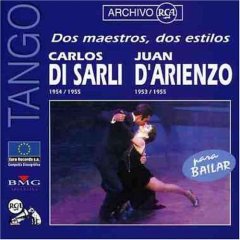
Di Sarli recorded 78 tracks during his final stay with RCA Victor (1954-1957) of which just 23 were instrumentals. Twenty of them are on the RCA Victor 100 Años cd; this CD gives us two more: Los 33 Orientales and Cuidado Con Los Cincuenta.
But the vocal numbers are also worthy of our attention, and Euro Records have reissued them all across 3 cds on Euro Records.


Finally, from time to time we are asked about the 1958 album on Polygram, in particular for the instrumentals Indio Manso and Una fija. Polygram did reprint this on CD, but it was deleted many years ago.
I want some of Di Sarli's very early recordings


Di Sarli's early sextet is charming - not quite as charming as early Fresedo or Canaro, but every bit as good for dancing. The Bluemoon CD is long deleted and the Colección 78rpm out-of-print, but you can hear him on Tango Collection.
Where next...
- Back to building a library
- Milonga home page